
Individuals
Most people come to me for sessions when they are ready for big transformations in the areas of love, sex and relationships. This could mean taking a current relationship to the next level, calling your dream relationship into your life, navigating grief, changing your career, or even consciously creating the life you truly want.
- Are you single? And would you really like a partner?
- Do you feel that it is difficult to sustain relationships?
- Would you like a long-term committed romantic companion?
- Would you like more fulfilment in love and sex?
My individual sessions involve building a sense of safety and trust, working through the resistance and negative belief patterns, and committing to having what you want.
I create a warm, empathic and supportive space, which is confidential, client-centred, non-judgemental, whilst working with your process and at your pace. I take you through a step-by-step process to explore what you want to change.
I am trained in Internal Family Systems, Emotionally Focussed Therapy as well as Psychosexual Therapy and Deep Brain Reorienting. Together we will explore what is happening in your system around sex and relationships. This is about empowering you to create and choose the relationships you long for.
Love Coaching
Just as you might hire a trainer to get fit, Love Coaching helps you strengthen your relationship skills and self-confidence. Together, we’ll explore your history, clear negative beliefs, and create a new love template.
This may include healing attachment wounds, building embodiment practices, and making dating feel fun, joyful, and successful.
Psychosexual Therapy
As a qualified Psychosexual Therapist, I support people struggling with aspects of their sexual selves. We’ll explore challenges such as loss of desire, confidence, or orgasm difficulties, and create a personalised plan for sexual and relational wellbeing.
This may involve exercises to increase embodiment, self-esteem, and intimacy, while clearing shame and negative feelings. My aim is to help you feel more empowered, connected, and able to enjoy a fulfilling sex life.

I am very experienced working with people who would like to become orgasmic and people who would like to find a partner.
I work with:
- Singles who want partners
- Building confidence and inner magnetism
- Developing communication skills
- Developing sexual experience
- Becoming orgasmic
- Porn addiction
- Low or lack of sexual desire
- Sexual shame
- Premature ejaculation
- Erectile dysfunction
- Vaginismus
- Dyspareunia
- Affairs
- Sexual identity
- Impact of religion on sexuality
This is a slide of DBR which was developed by Dr Frank Corrigan which helps people to process and release shock and affect from their system.
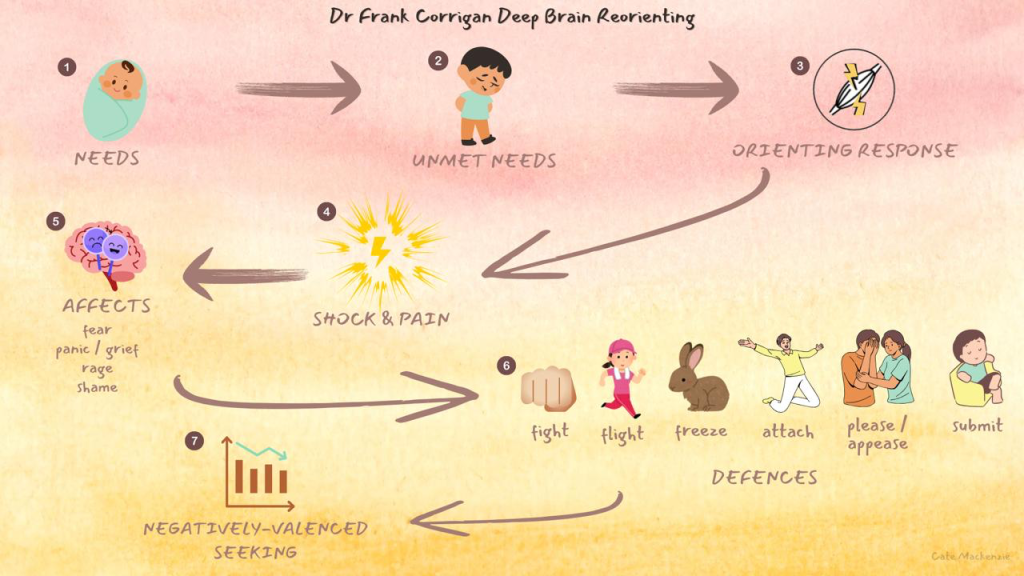
Deep Brain Reorienting (DBR)
Developed by Dr Frank Corrigan, Deep Brain Reorienting (DBR) is a body-based therapeutic approach that works with the connection between the brain, the body, and emotion. The idea is that when specific needs go unmet, we experience a shock in the midbrain that creates tension in the body. This tension generates negative feelings such as fear, grief, rage, or shame, which can then shape our attachment styles and behavioural patterns.
When our needs go unmet, the shock and emotional response can lead us to develop automatic coping mechanisms. We might find ourselves getting angry, shutting down, avoiding, or even trying to please others, all in an effort to ease the pain or find another way to have those needs met.
For example, if a person repeatedly experiences confusion or responses that do not make sense, whether from others or themselves, this may indicate that shock or emotion remains stuck and unprocessed in the body. In those moments, it can feel tricky to tune into your own instincts or to know what feels right deep down.
DBR helps to process that shock and emotion slowly through the body. As the process unfolds, old neural pathways, bodily tensions, and emotional patterns can begin to release. This may create more space for a person to connect with their inner essence and experience a calmer, less reactive nervous system.
In practice, a session begins by choosing an activating stimulus, which is something that evokes emotion or discomfort, such as a memory, sentence, or situation. I guide the person to settle into what is called their “where self,” with eyes closed, while remaining aware of both their body and the space around them. From there, we slowly notice what happens in the body, especially around the eyes, forehead, and base of the skull, as the brainstem turns toward the trigger. The pace is slow, allowing the body to process the waves of tension, tingling, or emotion that appear naturally.
Often, people describe that the original trigger feels as if it has dissolved or softened. Sometimes another, related memory or emotion arises that becomes the next layer to explore.
For instance, a woman might begin a DBR session focused on her wish to have a partner and later realise that unresolved hurt from past relationships is blocking her openness. Recognising this can start to create real change. Or a man might notice physical tension linked to pressure or performance anxiety. After DBR, he may find that his body responds more freely, revealing a deeper emotional theme to work with. It is a gentle process, almost like clearing old files from a computer so the system can run smoothly again.
Podcasts, Media & Relationship Work
One example of my Bridging work is helping two people move out of blame and defensiveness and into a space of understanding. Rather than staying stuck in who is “right” or “wrong,” I guide each person to connect with their own feelings and needs, and then communicate these in a way the other can truly hear. This creates a bridge between them, where empathy replaces conflict and a deeper connection becomes possible.
I spoke about this approach in more depth when I appeared on the Psychosexual Therapy podcast alongside Denise Van Outen and Eddie Boxshall, where we explored how Bridging works in practice and how couples can begin to shift out of conflict and into connection.
I also appeared on The Love Twats Podcast with Bibi Lynch and Guy Lloyd, where we spoke about dating, relationship patterns and the emotional blocks that can keep us stuck. During the conversation I gently asked Bibi whether there might be ways she was unconsciously protecting herself from intimacy or even sabotaging connection, something she wasn’t entirely sure about at the time.
Bibi shared that although she had been going on dates, they were rarely turning into relationships. She spoke about sometimes turning up wearing her dad’s old jumper and carrying a bag that said “Back Off”, which opened up an interesting conversation about the subtle signals we can send without realising it. At one point Bibi asked whether that meant she couldn’t simply be herself. I explained that the intention isn’t to change who you are, but to become aware of the protective patterns we all develop and consider whether they are still helping us when we want connection.
After the podcast, Bibi reflected further on our conversation. As she moved into a relationship, she reached out again for support, and we explored how a part of her that may have previously pushed partners away might respond now its role had changed. Together, we looked at how to recognise that part with compassion, rather than judgement, and how to work with it so it no longer needed to protect her in the same way.
She later wrote openly about her experience of being single since 1997 in her Good Housekeeping feature, and I was delighted to hear that she has since gone on to find a partner.
Journalist Marianne Power also wrote about attending one of my flirting workshops in Red Magazine, sharing how the experience helped her reconnect with playfulness, confidence and a greater openness to connection. In the article, she reflects on how the exercises encouraged her to step outside her comfort zone, let go of self-consciousness and approach dating with more authenticity and curiosity. Her experience highlights how creating a safe space for exploration and connection can help people move beyond fear and self-protection, allowing them to engage with others in a more natural and joyful way.
I also joined BBC Radio 4’s Woman’s Hour to discuss sex and intimacy in midlife. Drawing on my work as a psychosexual therapist and couples counsellor, I shared insights into the three main types of sex that tend to emerge in long-term relationships and how our needs around intimacy often evolve as we get older. We explored why emotional connection, communication and feeling safe with a partner can become increasingly important in our forties and beyond, and why this deeper, more connected form of intimacy is often the most satisfying in later life.
What people are saying
Cate is a very talented soul and helped me navigate through some very difficult times with a past love. I now find it easier to see the wood for the trees in the love department. These days the person I am truly in love with is myself.
Thank you Cate.
Claire